Lymphoedema is a chronic, progressive condition characterised by persistent swelling, most commonly of the lower limbs. While cancer and its treatments are well-recognised causes, non-cancer triggers – including obesity, reduced mobility, venous insufficiency and congenital lymphatic anomalies – are also common but often under-recognised. The broader term chronic oedema (CO), defined as swelling lasting longer than 3 months, has been proposed to improve early identification and management; however, awareness remains limited in generalist healthcare settings (Moffatt et al, 2003; 2019a).
In England, three systemic issues appear to hinder effective lymphoedema care: inconsistent diagnosis impeding appropriate referral, lack of standardised outcome measures and fragmented commissioning. The absence of a national lymphoedema policy has led to significant regional variation in England, a disparity not observed in areas with nationalised strategies, such as Wales (National Lymphoedema Partnership [NLP], 2019). Moffatt et al (2019c) demonstrated that a simple educational intervention markedly improved CO recognition in community nursing teams – from <10% to 60% – with 73% of those identified also presenting with a venous leg ulcer. These findings highlight that without accurate recognition, timely management or referral to specialist services may be delayed or absent.
Although the National Wound Care Strategy Programme (NWCSP) recommended referral for lymphoedema management once CO is identified, many regions lack commissioned services (NWCSP 2020, 2023). Disparities in access are common, particularly for non-cancer-related cases and may worsen symptoms, increase risk of cellulitis, promote fibrosis and raise healthcare costs (MacLaren, 2003; Keeley et al, 2019; Azhar et al, 2020).
A national shortage of lymphoedema specialists, limited CO knowledge among generalist healthcare practitioners and the complexities of safely discharging stable patients back to primary care for ongoing management further compound these challenges (NLP, 2019; O’Donnell et al, 2020). Together, these factors create a critical evidence and workforce gap, likely contributing to delays in access to lymphoedema treatment and underscore the need for improved education, commissioning and structured care pathways.
Service provision and access inequity
Pioneer provides specialist lymphoedema care. The service highlighted in this paper was originally commissioned to accept a limited number of referrals based on expected engagement. However, referral volumes soon exceeded commissioned capacity. The ICB responded proactively to a request for additional support to address the waiting list. As part of this Waiting list initiative (WLI), a structured harm assessment was introduced to quantify physical deterioration and psychological distress linked to waiting times. The assessment incorporated the ICB recommended standardised harm tool to use following a patient safety event and enabled duty of candour discussions (NHS England, 2023). The WLI focused on evaluating increases in limb swelling, fibrosis, infection risk and impacts on quality of life (QoL).
Clinical challenges in measuring harm
Measuring harm associated with CO presents inherent challenges. Although limb volume reduction or optimisation remains a key management goal, establishing a baseline for comparison is often unfeasible – particularly in bilateral limb involvement or truncal oedema, where no unaffected control limb exists (NLP, 2019; British Lymphology Society [BLS], 2025). Variability in measurement techniques and target setting across services further limits the reliability of limb volume as a standalone indicator of harm (International Society of Lymphology [ISL], 2023). Patient-reported outcome measures (PROMs), including perceived changes in tissue texture, physical function and QoL, may provide more meaningful insight, but require consistent implementation and documentation, which remain non-standardised across services (BLS, 2019; Gabe-Walters, 2023).
The LIMPRINT study identified a high prevalence of lower limb swelling (81.5%) and poor control in 27.2% of patients with CO, commonly associated with obesity, recurrent cellulitis, and delayed access to care (Moffatt et al, 2019b). Despite these associations, few studies have directly examined the physical and psychological burden arising from treatment delays. Although cellulitis prevention is recognised as a key clinical outcome evidence on best practice remains limited, with Cochrane reviews highlighting the need for further research (International Lymphoedema Framework, 2020; BLS and Lymphoedema Support Network, 2022).
Education-led initiatives, such as those implemented by the Welsh Lymphoedema Network (Thomas et al, 2024), have shown reductions in cellulitis incidence, suggesting that timely intervention may yield both clinical and economic benefits. These findings underscore the importance of early, equitable access to care to prevent disease progression and associated harms.
Although delayed access to treatment is often not explicitly addressed in the literature, non-adherence to compression therapy is strongly associated with disease progression, leading to trophic tissue changes and potential ulceration (ISL, 2023). Therefore, it is plausible that lack of timely access to such therapy could similarly contribute to progressive tissue changes and an increased risk of wounding. Indeed Keast et al (2014, 2021), reported that untreated CO is strongly associated with fibrosis, recurrent cellulitis, infection, delayed wound healing and, in severe cases, increased morbidity and mortality.
Aim
This paper reports the findings of the structured harm assessment. By evaluating the consequences of delayed access to specialist lymphoedema care, this study informed future service planning, commissioning models and workforce development in CO care.
The findings directly supported the development of a more responsive service model with capacity better aligned with patient demand. Findings are compared with patients attending the service under standard service care (SSC) parameters.
Methods
Literature search
To guide the development of the harms assessment protocol, a structured literature search was conducted in Ovid MEDLINE between 6 January and 30 June 2024. An initial filter excluding studies published before 2019 was considered, reflecting concerns about outdated or inconsistent lymphoedema guidance (O’Donnell et al, 2020). However, this restriction proved unnecessary: the search revealed a striking lack of recent evidence addressing waiting times or delayed access to CO care.
Search terms combining lymphoedema, health outcomes, and patient-reported outcome measures yielded 424 abstracts. When refined with additional terms, such as timely referral, waiting list or delay, the results decreased markedly. In more than 256,000 delay-related articles across the medical literature, only four referred to CO or lymphoedema. Two addressed unrelated conditions (tuberculosis and acromegaly), while the remaining two examined surgical or cancer-specific contexts, offering no data relevant to lymphoedema service delays.
This paucity may reflect either a genuine evidence gap or potential publication bias, in which negative or inconclusive findings regarding access delays are less likely to be reported – an issue in health-related research that has been highlighted as poorly addressed in the literature (Ayorinde et al, 2020). Given the well-documented regional variation and limited commissioning of lymphoedema services in England, the lack of evidence on the consequences of delayed care is notable (Keeley et al, 2019; NLP, 2019).
Crucially, the absence of evidence does not equate to evidence of no harm. The challenge of identifying patients requiring CO management pre-referral – and capturing the effects of delayed intervention at assessment – may contribute to the gap. Research in other chronic conditions, including diabetes and heart failure, consistently demonstrates that delayed diagnosis or treatment correlates with poorer outcomes, greater healthcare utilisation and reduced quality of life (Megari, 2013). Therefore, it is plausible that similar consequences occur in lymphoedema, underscoring the need for focused investigation.
Literature searching was limited to MEDLINE, which was considered appropriate, given its comprehensive coverage of peer-reviewed clinical research and use of controlled vocabulary to support precise retrieval. Although Embase is recognised as a valuable supplementary database, access was not available to the author due to subscription restrictions; this may have resulted in the omission of studies indexed exclusively elsewhere and is acknowledged as a limitation of the review. To partially mitigate this, reference lists of included studies and relevant reviews were screened to identify additional publications.
Assessing potential harms
To address the primary aim of identifying harms associated with delayed access to lymphoedema care, the commissioning ICB’s Quality Lead recommended applying the NHS England (2023) Patient Safety Incident Response Framework (PSIRF) to categorise harm severity. Although few of the framework’s indicators are specific to CO, the general principle of “reducing harm through early identification and treatment of deterioration” was considered applicable.
In the absence of lymphoedema-specific criteria within national harm definitions, a bespoke assessment matrix, to assess delay-related CO harm was developed by adapting language for relevance to patients with CO (Table 1). This matrix was applied prospectively during, or shortly after, the initial clinical assessment for each patient referred through the WLI. In some cases, harm categorisation incorporated early treatment response to determine whether physical or psychological changes were reversible or permanent.
Categorisation was assigned by the lead author, who observed each assessment, and was confirmed against the primary clinician’s opinion; any discrepancies – though infrequent – were resolved through consultation. This approach combined real-time clinical evaluation with short-term outcome insight, supporting consistent and robust harm classification while acknowledging the potential for subjective interpretation, particularly in the absence of a standardised harm assessment tool.
This matrix was developed specifically for this initiative, and further refinement and formal validation are required to confirm its reliability and wider applicability across other CO services. An early prototype tool, intended to accompany Table 1, is presented in Table 2; this version likewise requires refinement and validation. The tool integrates the widely used ISL CO disease staging system and LYMPROM© outcomes to support psychological harm categorisation (Gabe-Walters and Thomas, 2021; Şahinoğlu et al, 2024). Future iterations may offer clearer visual formatting, enhanced accessibility, and more structured guidance through expert collaboration and formal validation.
Notably, no patients were known to have died while on the waiting list, although several were uncontactable, hospitalised, or bedbound due to other comorbidity-related deteriorations, preventing assessment of whether poor CO management had contributed to their condition.
Recruitment and cohort inclusion
A total of 50 patients were initially included in the Waiting List Initiative (WLI). Of these, 29 attended for clinical assessment and intervention, while 21 were excluded for the following reasons:
- l Resolved CO prior to assessment (n=9)
- l Uncontactable (n=5)
- l Unable or unwilling to attend the commissioned ambulatory service (n=4)
- l Declined engagement (n=3)
Of the 29 attendees, eight were subsequently excluded from full outcome analysis due to:
- l Upper-limb swelling only (n=2).
- l Cognitive impairment precluding consent (n=2).
- l Declined all treatment despite consenting to assessment (n=2).
- l Referral received <8 weeks before project onset (no delay in treatment) (n=1).
- l Housebound, assessed at home outside WLI protocol (n=1).
This resulted in a final active cohort of 21 patients who underwent full assessment, treatment, and follow-up. Harm categorisation at the point of assessment was, however, completed for all 29 attendees.
For contextual comparison, the next 50 patients booked for Standard Service Care (SSC) at another Pioneer clinical site were invited to share outcome data. Their care was unaffected and harm was not directly assessed. After exclusions, a comparison cohort of 28 patients was available for outcome analysis. Baseline demographics were broadly similar between groups, with no significant differences in age (p=0.44), sex (p=0.126) or history of cellulitis (p=0.124). Although BMI differed initially (p=0.02), this was not confirmed on additional analysis using the Mann–Whitney U test, appropriate for small sample sizes; therefore, these factors were not considered to have influenced the observed and patient-reported physical or psychological outcomes.
Results
Harms review – wait time
According to the National Lymphoedema Partnership (2019), patients with CO should be assessed within 8–10 weeks of referral, or within 2 weeks for urgent or palliative cases. In the WLI cohort, the mean wait time was 65 weeks, substantially exceeding the national target. Only two patients were assessed within the 12-week target previously commissioned by the ICB (Figure 1).
Physical harm review
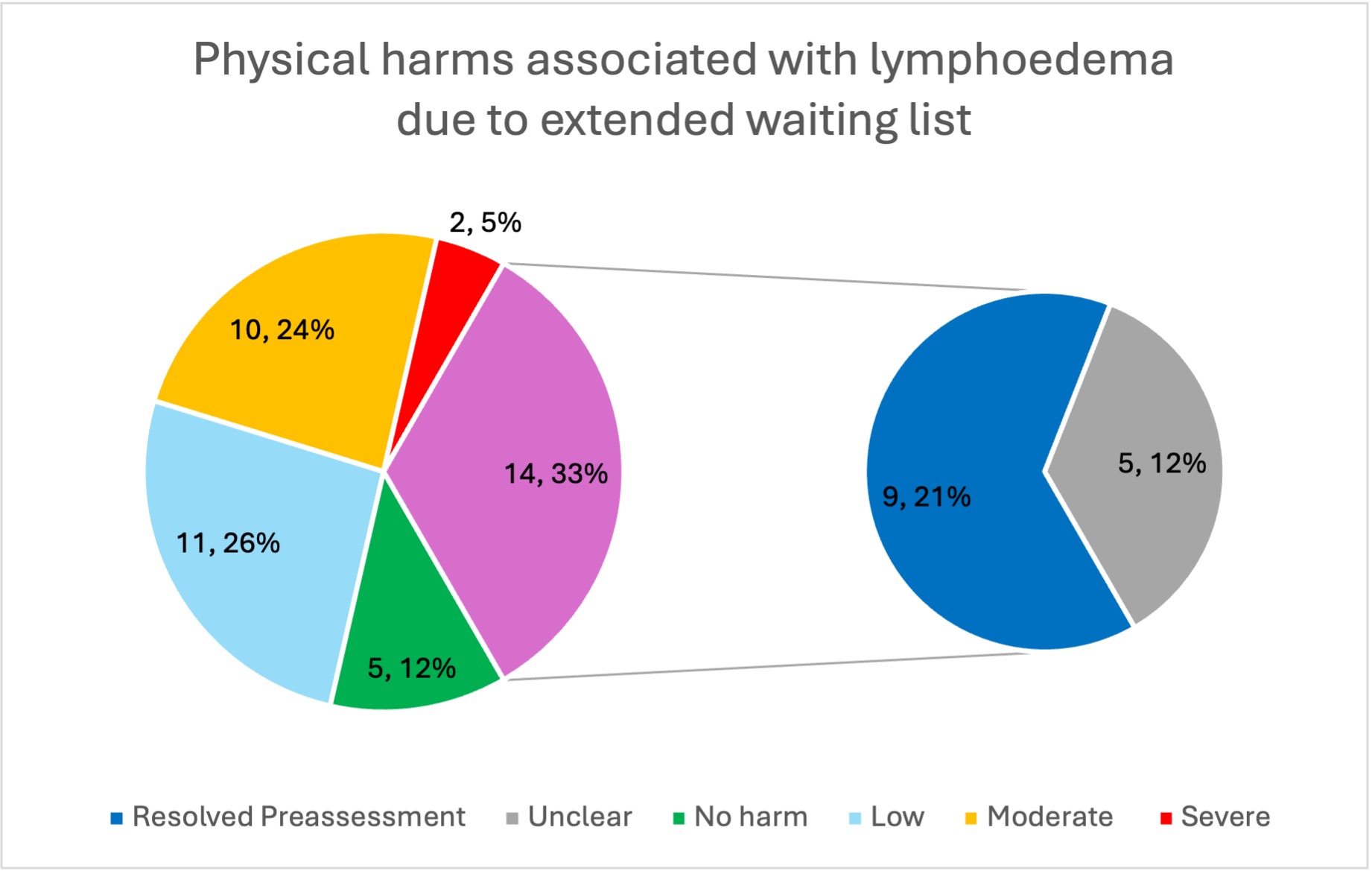
All patients attending the clinic were categorised using ISL CO staging and the harm matrix described in Table 1 and Table 2. Physical harm was defined by clinical findings, ISL stage, and the intensity of treatment required (Figure 2). For 14 patients (33%), physical harm could not be categorised; these cases were excluded from the final harm outcome analysis, but documented as part of the overall service audit. Where relevant for patient safety, follow-up phone calls were made 1–2 months post-project initiation to confirm that oedema had remained resolved or that patients continued to decline care before discharge back to their GP.
A summary of outcomes and interventions is provided in Table 3. Statistically significant reductions in limb volume were generally observed across WLI and SSC cohorts, with mean reductions consistent between groups (Figure 3). However, individual patients demonstrated larger changes with tailored interventions, including wrap use (patient P09) or intensive decongestive bandaging (R10). Notably, P09 had been categorised as severe physical harm due to skin changes and functional limitations but achieved marked improvement through consistent use of compression wraps, exercise and skin care. Substantial increases in limb volume were associated with trauma-related cellulitis or poor engagement with wrap garments, while mild increases reflected patient choice to maintain oedema, inconsistencies in garment use, or natural fluctuations due to time of day or seasonal factors (January–April), when assessments were conducted.
The highest burden of cellulitis was reported by eight patients, who experienced a total of 46 episodes within the preceding 1–5 years (Figure 4). This period typically encompassed time spent on the waiting list. One patient required a 14-day hospital admission for cellulitis within the past year; however, it is unclear whether this episode precipitated the initial referral to CO services or occurred during the waiting-list interval.
Psychological harm review
Assessment of psychological harm was challenging due to the absence of a clinical psychologist and the prior lack of an integrated quality-of-life tool. LYMPROM scores, considered alongside patient responses and behaviour during assessment and supported by the harm matrix (Tables 1 and 2), were used to categorise psychological harm. Individual question response rates were consistent between WLI and SSC, as well as with those reported during the tool’s validation, suggesting appropriate use and implementation was adhered to (Gabe-Walters and Thomas 2021). Observed emotional distress and the anticipated support needed to address challenges arising from delayed care were incorporated into the assessment.
It was not possible to assign a psychological harm category for 41% of patients (n=17):
- l Resolved CO prior to assessment: 22% (n=9) had no reported psychological symptoms
- l Incomplete data or barriers to assessment: 19% (n=8) included patients with acute illness, cognitive impairment or who declined participation, limiting LYMPROM completion and engagement; one patient was assessed within a normal referral timeframe and thus excluded from the WLI review.
Among patients with completed assessments, psychological harm ranged from low to severe. Those requiring frequent support or showing high distress during initial appointments typically fell into moderate-to-severe categories. Emotional responses included frustration, disengagement or reduced trust in services, even when physical symptoms were mild due to the prolonged wait.
Conversely, two patients – one with primary lymphoedema requiring specialist garments and another with moderate CO due to wheelchair use – reported no psychological harm. Both were experienced in navigating CO service barriers and were satisfied with the education and compression garments provided. One patient declined further support, preferring the garment be added to his repeat prescription after demonstration.
Psychological harm allocation
Psychological harm was considered as no harm or low in 28% of patients (n=12). Six patients (14%) reported no distress: three had mild or resolving oedema unaffected by the waiting period, while three had long-standing CO – including one with primary lymphoedema since childhood and another with lower limb paralysis – who were confident in self-management and reported no distress linked to the delay (Figure 5).
A further six patients (14%) were assessed as having low psychological harm, reporting mild body image concerns or clothing-related frustration, low LYMPROM scores (0–30/100), minimal emotional distress and no major disruption to daily activities. Most required only a single educational appointment and garment provision to feel reassured.
Moderate psychological harm was recorded in 24% of patients (n=7), all scoring mid-range on LYMPROM (mean 68.4/100, SD ±8.9). Swelling affected daily activities, emotional wellbeing and body image. One patient with obesity-related oedema was particularly impacted by weight-linked stigma and received counselling. Harm in this group was considered prolonged (over 2 weeks) and at the higher end of the internally recommended LYMPROM threshold for moderate harm, but likely to resolve within six months with appropriate intervention.
Severe psychological harm was observed in 21% of patients (n=6), with high LYMPROM scores (>75/100) and significant emotional distress. Key themes included loss of independence, delayed access to appropriate services (e.g. dermatology, rheumatology) and the psychological impact of chronic or misunderstood symptoms. One patient had been on the waiting list for over 500 days, while another, assessed 20 days post-referral, experienced prolonged distress due to earlier referral delays, meeting criteria for harm associated with delayed access to care.
Notably, one patient had been severely distressed after being incorrectly told her leg swelling was solely due to her weight, despite a BMI of 20.4 and presentation consistent with lipoedema. While she was partially reassured that her condition was not weight-related, her psychological scores increased at review due to lack of curative treatment, heightened awareness of her legs and difficulties with support garments. Her distress stemmed from the prior misdiagnosis and may have been exacerbated by the delay in receiving appropriate specialist care.
Most patients demonstrated substantial reductions in total LYMPROM scores (Figure 6). Although final mean score did not differ significantly between cohorts (p=0.284), the reduction in the WLI group approached clinical significance (p=0.065), with a mean decrease of 40.4% (SD ±33.9) compared to 17.6% (SD ±52.9) in the SSC group. Notably, the WLI cohort also demonstrated less variability in score reduction. These findings suggest greater quality-of-life improvements among WLI patients, potentially reflecting the impact of prolonged waiting times on baseline QoL or increased perceived benefit once specialist care was accessed, despite minimal differences in mean limb volume reduction (<0.25%) between groups. Trendline analysis of individual total scores indicated WLI scores were approximately 10% higher than SSC at assessment. Reductions in individual LYMPROM items (Figure 6) were generally greater in the WLI cohort, except for finances, body image and anxiety.
Discussion
This study explored harms linked to delayed access to specialist lymphoedema care. Psychological and physical harm were assessed using a bespoke matrix alongside LYMPROM scores. Swelling duration was compared between WLI and SSC cohorts using ordinal categories extracted from the standard assessment notes; (under 1 year=0; 1-5 years=1; 5-10 years=2; >10 years=3) to enable statistical analysis.
A significant difference was identified between groups (p=0.018), with shorter reported duration in the SSC cohort, however, the grouped analysis provided limited insight into the distribution likely due to the wide range standard within assessment notes. To improve interpretability, categorical frequencies were examined. Given the small sample size, Fisher’s exact test was used alongside Chi-square analysis, confirming a statistically significant difference between cohorts (p=0.031). The SSC group included a higher proportion of patients with recent onset (<1year), whereas no WLI patient’s fell into this category (SSC 8 : WLI 0).
Conversely, the WLI group had a greater proportion of long-duration swelling (>10years) (SSC 3; WLI 6). The 1-5 and 5-10 categories were broadly comparable between groups. However, while LYMPROM scores aligned closely with psychological harm, no clear correlation was found between wait time and harm level, likely due to small sample size, variability in CO presentation, and individual patient factors. Future evaluations of the impact of delayed care should incorporate systematic recording of date of symptom onset and compare this with both referral and first assessment dates, to better characterise the relationship between delay and harm. In addition, capturing patient-initiated delays or deferrals, as well as engagement with treatment may enhance understanding of lymphoedema-associated harm trajectories.
Several illustrative outliers highlight this complexity: one patient waited over two years but had minimal oedema from a resolved ankle sprain; a patient with paraplegia reported little distress despite significant swelling; conversely, a patient with lipoedema experienced severe psychological distress despite mild limb changes due to misdiagnosis and absence of curative treatment. Another patient, assessed within 20 days, reported severe distress stemming from previous referral delays. These examples suggest that personal context and prior healthcare experiences may influence harm more than wait duration alone. Anecdotal patient feedback within treatment consultations reinforced previous literature: limited awareness of CO among generalist healthcare professionals contributes to misdiagnosis, delayed referral and psychosocial impact, affecting mobility, confidence and engagement in daily activities (Costello et al, 2021). Post-assessment improvements in limb comfort, mobility, and self-management likely drove observed quality-of-life gains.
Limitations
Limitations include small sample size, heterogeneity, and attrition, which may have obscured direct associations between wait time and harm. Future studies should employ larger, prospective designs with robust triage and standardised outcome measures to clarify the impact of delayed access to specialist care.
Conclusion
This study highlights the tangible harms associated with delayed access to specialist lymphoedema care – harms that are rarely reported in the literature despite the known link between poor CO management and disease progression. Patients on the waiting list experienced a spectrum of physical and psychological consequences, from preventable fibrosis and recurrent cellulitis to severe emotional distress, misdiagnosis, and reduced quality of life. While wait time alone did not statistically predict harm – likely due to small sample size, heterogeneity and individual patient factors – clinical observation and patient-reported outcomes indicate that prolonged delays exacerbate the burden of disease and complicate management.
These findings underscore the importance of timely referral pathways, adequate service capacity, and comprehensive patient support. They also reinforce the value of adopting a clear, standardised framework for recording and evaluating harm associated with delayed access be that from initial symptom onset or referral to assessment. Wider implementation of such an approach across NHS lymphoedema services would facilitate more consistent data capture, enabling better understanding of the impact of delays at both local and national levels. Collectively, the findings demonstrate a fundamental truth: living with lymphoedema is not a neutral experience, and delays in care only magnify its impact.
Ethics
This proposal is based on secondary analysis of data derived from a previously completed service evaluation submitted to and reviewed by the University of Cardiff Ethics Committee, which confirmed its classification as service evaluation rather than research. The current work constitutes a retrospective harms assessment developed from the outcomes of that evaluation.
No new data collection has been undertaken and there has been no additional patient contact, intervention, or alteration to clinical management. All data used were generated as part of routine NHS care and the original service evaluation process. Accordingly, the present analysis does not involve any modification to patient treatment pathways and does not introduce additional risk to participants.
Acknowledgements
The author thanks Dr Cheryl Pike (Lymphoedema Network Wales) and Samantha Holloway (Cardiff University) for their valuable insight, guidance and constructive feedback during the development of the original work from which this project arose. Their early input helped shape the conceptual direction prior to its separation from a master’s dissertation. The author also gratefully acknowledges Prof Jenni MacDonald (Pioneer Wound Healing and Lymphoedema Centres): Provided scientific advice on the study and played a fundamental role in shaping the inception, direction and progression of the project. She critically reviewed the study protocol and manuscript and provided ongoing encouragement, support and critical input throughout its development.