Head and neck cancer (HNC) accounted for approximately 3.3% of new cancer diagnoses in Australia in 2025, corresponding to 5,577 new cases (Cancer Australia, nd). Head and neck lymphoedema (HNL) is a common sequela of HNC treatment, particularly neck dissection and radiation therapy, which can disrupt lymphatic drainage and cause swelling of the external tissues of the face and neck, the internal pharyngeal and laryngeal structures, or both (Hack et al, 2026).
Published HNC cohorts generally have mean or median ages of 59–67 years (Gaitatzis et al, 2026), whereas younger survivors form a smaller but relevant subgroup (Stubblefield and Weycker, 2023). Accordingly, this study focused on adults aged 18-40 years to examine cervical and mandibular movements while limiting age-related variability in cervical range of motion (Thoomes-de Graaf et al, 2020).
Reported HNL prevalence after HNC treatment varies by treatment modality, assessment timing, and measurement method, with some studies reporting rates approaching or exceeding 90% (Gaitatzis et al, 2026). Despite this, HNL remains underrecognised, underdiagnosed, and undertreated, while the lack of standardised diagnostic and assessment approaches may contribute to inconsistent identification, classification and prevalence estimates (Arends et al, 2023; Stubblefield and Weycker, 2023; Van Aperen et al, 2025).
HNL may adversely affect swallowing, cervical mobility, pain, and overall physical function (Gaitatzis et al, 2026). Greater swallowing impairment has been associated with more severe external or internal HNL and more diffuse internal involvement (Jeans et al, 2023). HNL may also negatively affect quality of life, with patients reporting psychological distress, changes in self-identity, and appearance-related concerns (Starmer et al, 2023).
Complete decongestive therapy (CDT) – including manual lymph drainage, compression, exercise and skin care – is the most common conservative treatment for HNL and has the strongest evidence base, although benefits are modest and variable (Arends et al, 2025; Rajaram et al, 2025). Multimodal physical therapy may improve external, but not internal, HNL; however, trials are heterogeneous and consensus is lacking on the importance of individual CDT components (Arends et al, 2025; de-la-Cruz-Fernández et al, 2025).
Aims
This study examines neck–mouth kinematics in healthy young adults and their potential effect on anterior neck tissue excursion to inform exercise prescription for HNL.
Methods
Study design and ethics
This observational cross-sectional study recruited healthy volunteers who completed a single 30-minute laboratory assessment at the University of Queensland, Brisbane, Australia. The study was approved by The University of Queensland Human Research Ethics Committee (2019000302). All participants provided written informed consent before data collection.
Participants and recruitment
Healthy volunteers aged 18–40 years were recruited by convenience sampling within the university community. Participants were excluded for clinically significant neck or jaw pain within the previous 6 months; conditions affecting the cervical spine; previous cervical surgery or whiplash-associated disorder; pregnancy or childbirth within the previous year; vertebral artery insufficiency; vestibular disorders; extension-induced dizziness; or temporomandibular joint pain or dysfunction.
Outcome measures
Cervical flexion and extension active range of motion (AROM) were measured in degrees using a CROM cervical range-of-motion device (Performance Attainment Associates). Maximal mouth opening (MMO) was measured in centimetres between the central incisors using a sanitised ruler, and anterior neck skin excursion in millimetres using a tape measure. Age and sex were self-reported; height and body mass were measured, and BMI was calculated.
Testing procedure
Participants were seated with feet flat, hands on thighs and back supported and received standardised verbal instructions. After three warm-up repetitions of cervical flexion and extension, cervical AROM and MMO were measured three times and averaged. Cervical flexion and extension AROM were measured from neutral using the CROM device. MMO was measured in neutral and maximal cervical extension. Cervical extension AROM was then measured from relaxed-open and mouth-closed (MC) starting positions, returning to neutral before each trial.
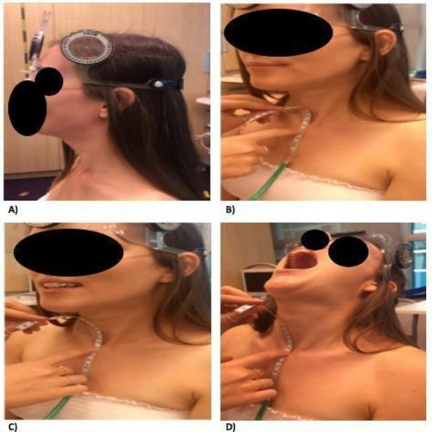
For Pattern A, participants started relaxed-open, extended to end range, closed the mouth and then opened to MMO. For Pattern B, participants started MC, extended to end range, opened to MMO and then closed the mouth. The anterior lip of the sternal notch was marked, and a tape measure was fixed so that the 10 cm mark aligned with the sternal notch. The free end was held lightly against the anterior neck, and displacement between MC and MMO was calculated for each repetition and pattern (Figure 1).
Sample size
An a priori sample size calculation using G*Power v3 (Faul et al, 2007) indicated that 36 participants were required to detect a 6° difference in cervical extension AROM between MC and relaxed-open starting positions, based on an effect size of 0.42 derived from Greenbaum et al (2017). The reported minimal detectable change for CROM-measured cervical extension is 5.1° at 90% confidence in healthy adults (Audette et al, 2010).
Data analysis
Data were analysed using IBM SPSS v25 (IBM Corp) with α=0.05. Normality was assessed using Shapiro-Wilk tests. Analyses were structured into four phases:
- l Phase 1: Cervical spine flexion and extension AROM.
- l Phase 2: MMO in neutral cervical spine versus MMO in maximal cervical spine extension.
- l Phase 3: Cervical spine extension AROM starting with mouth relaxed-open versus starting with MC.
- l Phase 4: Pattern A versus Pattern B.
To examine associations with sociodemographic variables in phases 1–2, age and BMI were categorised using sample medians:
- l Above or below the median age of 25 years.
- l Above or below the median BMI of 23.91 kg/m².
In phases 1–2, associations between cervical AROM (flexion, extension) or MMO (neutral cervical spine, maximal cervical extension) and age group, sex and BMI group were assessed using independent-samples t-tests. Paired comparisons in phases 2–4 used paired t-tests (parametric) or Wilcoxon signed-rank tests (non-parametric). Data are presented as mean (SD) or median (interquartile range [IQR]), as appropriate.
Results
Participant flow and sample characteristics
Forty-one participants were included in the analysis (Figure 2).
Participants were 54% male (n=22) and 46% female (n=19;Table 1).
Summary statistics for measurements across all phases are detailed in Table 2.
Phase 1: Cervical spine AROM and participant characteristics
Cervical extension AROM was greater in females than males (mean [SD] 76.11° [12.32] versus 63.71° [12.71]; p=0.003) and in participants below versus above the median BMI (mean [SD] 75.78° [13.42] versus 63.43° [11.63]; p=0.003). No other associations were identified.
Phase 2: MMO and participant characteristics
Participants below the median age had greater MMO in cervical spine extension than those above the median age (mean [SD] 5.46 cm [0.63] versus 4.95 cm [0.80]; p=0.032). Males had greater MMO than females in both neutral (mean [SD] 5.29 cm [0.67] versus 4.67 cm [0.72]; p=0.006) and extension (mean [SD] 5.44 cm [0.69] versus 4.90 cm [0.75]; p=0.022). No other associations were identified.
Phase 2 (paired comparison): MMO in cervical spine neutral versus extension
MMO was greater in cervical spine extension than neutral (Wilcoxon signed-rank test: median [IQR] 5.27 cm [4.83–5.83] versus 5.10 cm [4.77–5.37]; p<0.001; Table 2 and Figure 3).
Phase 3: Effect of starting mouth position on cervical spine extension AROM
Extension AROM was greater when starting relaxed-open versus mouth closed (paired t-test: mean [SD] 76.78° [16.31] versus 71.54° [15.09]; mean difference 5.24°; p<0.001; Table 2 and Figure 4).
Phase 4: Effect of starting mouth position on anterior skin excursion
Anterior neck skin excursion did not differ between starting positions (Wilcoxon signed-rank test: median [IQR] 1.67 mm [1.33–2.33] for both; p=0.289; Table 2 and Figure 5).
Discussion
This study examined cervical-jaw coupling and whether starting mouth position affected anterior neck skin excursion. MMO increased in cervical extension, and extension AROM was approximately 5° greater when starting relaxed-open; however, no detectable between-pattern difference in skin excursion was observed. These findings may inform HNL exercise selection, although the small excursion values and healthy sample limit interpretation.
Cervical-jaw coupling aligns with evidence that mouth opening accompanies and increases with head extension (Prodoehl et al, 2022), while craniocervical posture is associated with sagittal mandibular position (Zokaitė et al, 2022).
The absence of detectable between-pattern differences suggests that tape-measured anterior neck skin excursion was similar across the movement sequences examined, although subtle differences may not have been detected by this method. Tape measurements are simple and commonly used clinical methods for quantifying facial and neck dimensions in HNL assessment (Chotipanich and Kongpit, 2020; Arends et al, 2023; Van Aperen et al, 2025). Although standardised neck circumference measurements can demonstrate high reliability (Arends et al, 2023; Van Aperen et al, 2025), measurement performance varies across sites and protocols (Arends et al, 2023) and may be influenced by landmark identification, head and neck movement, tape placement, tape tension, and procedural consistency (Chotipanich and Kongpit, 2020; Van Aperen et al, 2025). Unlike these circumference-based approaches, the present study measured linear anterior neck skin excursion relative to the sternal notch. Because the validity of this specific method for detecting movement-related tissue displacement has not been established, the findings should be interpreted as showing no detectable difference rather than equivalence between movement sequences.
Clinical translation should be approached cautiously because findings were derived from healthy younger adults, whereas HNL cohorts are generally older, including an HNC-related lymphoedema cohort with a mean age of 58.0 years (Gaitatzis et al, 2026; Stubblefield and Weycker, 2023). Post-head and neck cancer treatment changes to soft tissue, lymphatics, and neuromuscular control may further alter movement strategies; for example, reduced cervical AROM has been reported following neck dissection (Gane et al, 2019). Nonetheless, these normative kinematic data may serve as a reference for future studies in head and neck cancer populations.
Future research should consider objective methods for more detailed characterisation of anterior neck tissue change, including ultrasound, magnetic resonance imaging (MRI), and local tissue water assessment (Vargo et al, 2024; Van Aperen et al, 2025), alongside three-dimensional (3D) surface imaging, which has demonstrated construct validity and variable responsiveness for measuring postoperative facial and neck soft-tissue changes (Buitenhuis et al, 2025). Whether these methods can feasibly quantify movement-related anterior neck tissue displacement in HNL populations, and whether measured changes correlate with swelling, symptoms, and function, remains to be established.
Conclusion
HNL is a common late effect of head and neck cancer treatment, yet evidence guiding the sequencing and positioning of cervical and jaw exercises remains limited. In this healthy young cohort, MMO was greater in cervical extension than neutral, and cervical extension AROM was modestly greater when starting relaxed-open versus MC. Starting mouth position did not produce a detectable difference in tape-measured anterior neck skin excursion, although subtle differences may not have been captured by this method. These findings highlight cervical spine-jaw kinematic coupling as a consideration when selecting and sequencing exercises, while cautioning against direct translation to people with HNL. Future research should evaluate these patterns in post-treatment HNC populations using more sensitive measures and clinically meaningful outcomes (e.g., swelling, symptoms, function) to determine whether a relaxed-open start improves lymphatic drainage or patient-reported benefit.