Maceration is a frequently discussed issue in wound care, yet its definition and contributing factors are often underestimated or oversimplified. It refers to the softening and breakdown of skin resulting from prolonged exposure to moisture, typically presenting as swollen, pale, wrinkled, or fragile periwound tissue that can compromise healing (Wounds UK, 2013; World Union of Wound Healing Societies [WUWHS], 2019). Skin is the largest organ of the body, measuring up to 2m2 and weighing approximately 4.5–5kg in an average adult, equivalent of 12−15% of total adult body weight. The skin comprises three layers: epidermis, dermis and hypodermis (Wysocki, 2016; Jiao et al, 2024). When skin integrity is compromised, tissue fluid effusion gives rise to wound exudate, a critical determinant of wound moisture (Fan et al, 2024). Excessive exudate can lead to overhydration of tissues and impede normal healing, particularly in chronic wounds (Parnham, 2002). Poor exudate management, including failure to address underlying causes such as venous hypertension, can lead to maceration, periwound skin damage and increased infection risk, all of which delay healing (Gardner, 2017).
Although maceration is commonly linked to excessive wound exudate, it is not solely caused by fluid accumulation. Additional contributing factors include inappropriate dressing selection that fails to manage moisture effectively, poor dressing adherence or seal leading to leakage onto surrounding skin, extended wear time without dressing changes in combination with retention capacity, patient-related issues such as immobility or incontinence and environmental conditions including humidity and temperature (Voegeli, 2012).
Beyond its relevance for nursing practice, maceration has important implications for medical decision-making (Whitehead et al, 2017). In surgical and medically complex patients, unrecognised or poorly managed maceration may compromise wound healing (Whitehead et al, 2017), impair suture stability (Sandy-Hodgetts et al, 2023) increase the risk of infection (Whitlock et al, 2025), and increase wound size due to devitalised tissue that requires removal. In specialties such as vascular surgery, plastic surgery and dermatology, the condition of the periwound skin plays a critical role in determining the timing and feasibility of operative or interventional procedures. When maceration is misclassified as pressure-related skin damage or as a superficial irritation, inappropriate management strategies may be implemented. This can result in delayed healing and unnecessary escalation of treatment. A structured and standardised assessment of maceration therefore supports interprofessional decision-making and more targeted therapeutic interventions.
Maceration should be considered a dynamic process rather than a static clinical condition. Early and often subtle changes in the periwound skin, such as increased shininess, pallor, altered skin turgor or a softened texture, may indicate the onset of maceration before visible skin breakdown occurs. These early signs are frequently overlooked in routine wound assessments. Systematic recognition of such changes provides a critical opportunity for timely preventative interventions. Incorporating early indicators into maceration assessment supports proactive management and may reduce progression to more severe skin damage.
Misclassification of maceration can have significant clinical and organisational consequences. When maceration is incorrectly identified as pressure-related skin damage or device-associated injury, management strategies may fail to address the underlying cause. This can lead to delayed healing, unnecessary treatment escalation and increased use of healthcare resources including financial resources and healthcare professionals’ time. Inaccurate classification also limits the ability to reliably document quality of care and patient safety outcomes. As a result, maceration may remain under-recognised as a distinct and preventable complication. Clear differentiation supported by standardised assessment is therefore essential.
For patients, uncontrolled exudate may cause pain, malodour, social withdrawal and psychological distress, including feelings of helplessness (Whitehead et al, 2017). Inadequate exudate and fluid management can lead to increased dressing changes, increased treatment costs, prolonged healing times and increased healthcare professional visits or prolonged inpatient stays.
Managing wound exudate to prevent maceration presents significant clinical challenges, particularly in accurately assessing exudate levels that fluctuate over time, selecting dressings that balance absorption with moisture retention, maintaining periwound skin integrity without over-drying and ensuring timely dressing changes that do not unnecessarily disrupt healing. Effective prevention requires patient and caregiver education on appropriate wound care techniques, highlighting the complexity of maceration management in clinical practice.
This paper presents the results of a qualitative project using focus groups to explore and investigate systemic issues related to prevention, assessment, early identification and management of maceration and to develop an assessment tool. The maceration assessment for exudate (MATE) tool developed through this work is intended to extend beyond simple documentation of presence or absence. It aims to support structured evaluation of severity, likely cause and associated clinical actions. By linking maceration assessment to dressing performance and exudate characteristics, the tool can assist clinicians in evaluating whether current wound management strategies are effective. The tool is designed for use across both acute and community care settings. It also offers potential for integration into digital wound assessment systems, supporting consistency and shared clinical understanding.
Ethical approval was given by the University of Huddersfield’s Research Integrity and Ethics Board.
Methods
Two virtual focus groups, held one month apart, were conducted with international key opinion leaders (n=7) to explore clinicians’ experiences in managing maceration in patients with acute and chronic wounds. The discussions were structured to capture diverse clinical perspectives and were designed to inform the development of a standardised maceration assessment tool focusing on exudate. The overall aim was to investigate clinicians’ experiences in managing maceration in patients with acute and chronic wounds and development of a maceration tool.
A convenience sample of seven recognised key opinion leaders were recruited from across the UK and internationally, using purposive sampling (Golzar et al, 2022) to recruit participants engaged in the management of acute and chronic wounds. Potential participants were invited via email to join focus groups, with the invitation including a participant information sheet (PIS) and focus group dates and times. Invitees were given one week to review the PIS and consider participation. Those who expressed interest were contacted by the researcher, who provided further details. Once interest was confirmed, participants received a consent form by email; a virtual meeting was then arranged to explain the project in detail and address any questions, after which formal consent was obtained.
Participants included four tissue viability specialists, one vascular nurse consultant and two surgeons, representing the UK, Singapore, Taiwan, Germany and Chile.
Two focus group sessions, each lasting two hours, were conducted virtually via Microsoft Teams. All data was recorded and stored on the University of Huddersfield’s secure drive, with recordings destroyed following transcription. Participants’ contact details were maintained in a secure server folder accessible only to the research team.
Prior to the first focus group, a topic guide was developed through a review of the literature and the clinical expertise of the focus group facilitator (KO) to structure the discussions. This initial session explored the impact of maceration on wound healing, patient experience and clinician workload. It also examined the development of a maceration assessment tool designed to identify features across four levels of severity, map corresponding clinical treatment pathways and inform a health economic model in which higher-grade maceration was associated with increased costs.
The second focus group was held 6 weeks after the initial session and centred on the development and refinement of the maceration scale. Participants reviewed the draft tool and discussed its clinical utility and usability.
Data analysis
Analysis followed Braun and Clarke’s (2006) principles of thematic analysis, a flexible, theoretically independent framework widely used in qualitative research. This approach allowed the identification and interpretation of recurring patterns across participant experiences.
Discussion
The group explored classification of maceration within the broader framework of moisture-associated skin damage (MASD) reflecting on clinical perspectives, terminology inconsistencies and the need for clearer guidelines to support practitioners in managing moisture-related complications effectively.
Rethinking terminology: Maceration versus MASD
The group raised a critical question regarding the classification of maceration: why is it not universally considered a form of MASD, despite fitting the criteria of moisture-induced skin damage? While MASD is widely recognised in the context of incontinence, its language and application are inconsistently used in wound care. This discrepancy may stem from professional roles; for example, vascular clinicians may not routinely use MASD terminology compared to tissue viability nurses.
The suggestion was made to consider maceration as a cross-cutting theme within the MASD framework. This would align with global definitions, which already include prolonged exposure to body fluids, such as urine and wound exudate, as contributing factors to MASD.
The group emphasised that maceration is a distinct form of skin damage within MASD. While it shares features with incontinence-associated dermatitis (IAD), maceration is characterised by unique mechanisms, clinical presentations and implications for patient care, and as such requires more attention and consideration.
Differentiating maceration from other skin damage
Maceration is a distinct form of skin damage, which can occur across all existing pillars of MASD. The wound aetiology simply distinguishes the type of fluid that causes the skin damage, e.g. incontinence in IAD and exudate in wound-related skin damage. Maceration carries important clinical implications, particularly when misclassified as other forms of skin damage such as pressure ulcers/injuries or device-related trauma. Such misdiagnosis can delay appropriate treatment and increase the risk of complications for patients. Therefore, effective management relies on accurate identification of the underlying cause, which may include factors such as oedema, environmental humidity, inappropriate dressing selection, or misuse and inadequate moisture control.
Recognising these distinct mechanisms is essential to guide timely and targeted interventions that preserve skin integrity and support optimal wound healing outcomes.
Clinical implications of excess moisture
Moisture is not inherently detrimental; its beneficial contribution to wound healing has been well established since the 1950s (Winter, 1962, 1963, 1965; Winter and Scales, 1963). The challenge arises when moisture becomes excessive, as this can undermine skin integrity and result in maceration. It is worth noting that excess moisture caused by saliva, particularly in relation to head and neck cancer surgery, can pose difficulties when present in large amounts, functioning as a vehicle for bacterial transfer and accelerating tissue breakdown (De Pascale et al, 2025).
Excessive wound exudate can:
- Destroy the skin barrier.
- Promote inflammation and infection.
- Increase risk of bacterial infection.
- Increase risk of fungal infection.
- Facilitate the release of proteases and exotoxins.
- Lead to invasive tissue damage.
- Result in tissue death or destruction.
The clinical challenge lies not in the presence of moisture, but in managing its volume, proteolytic and microbial content.
Building on the earlier discussion of moisture-related skin damage, the following section examines the specific contribution of wound exudate to the development of maceration.
Balancing moisture: Dressing dynamics
Effective wound management requires maintaining a delicate balance between exudate production and dressing absorption and retention. It is essential to address underlying causes of exudate and to initiate compression therapy without delay, particularly for lower limb wounds. If exudate exceeds the dressing’s capacity, or ability to retain fluid, maceration may occur. Conversely, overly absorbent dressings and high fluid retention may desiccate the wound, hindering healing.
Scheduling of healthcare professional visits and service capacity
One of the key operational barriers identified was the misalignment between dressing regimens and home/community nursing visits. Although appropriate dressings may be selected, their effectiveness is compromised when dressing changes are not performed at clinically appropriate intervals. In the UK, community nursing visits are often scheduled on fixed days (e.g. Tuesdays and Thursdays, or Mondays, Wednesdays and Fridays), driven by staffing capacity, rather than clinical need. This fixed scheduling can lead to delayed dressing changes, increasing the risk of maceration.
Product knowledge and formulary use
The importance of education and clinical reasoning emerged as a recurring theme, with participants highlighting the need to strengthen wound care education. Clinicians frequently rely on manufacturer recommendations, due to limited formal training, resulting in uniform dressing use across diverse wound types. Participants emphasised the value of teaching dressing indications and contraindications, linking product selection to wound aetiology and avoiding unnecessary use of antimicrobial dressings to reduce the risk of antimicrobial resistance and an overuse of foam dressings. The group agreed there was a widespread lack of understanding among clinicians regarding dressings available on local formularies, which may undermine appropriate product selection and placement, particularly in relation to fluid volume, exudate volume and wound type. In response, some teams have introduced exudate pathways and product placement guides to support clinical decision-making; however, the effectiveness of these tools remains limited by inconsistent education and training.
Participants emphasised the importance of differentiating between types of fluid and their associated risks of maceration, including those arising from IAD, leg ulcers, gastrostomy sites and tracheostomy sites. Skin protection and dressing selection were considered critical and should be tailored to the source, viscosity and nature of the fluid or effluent to optimise management and prevent skin breakdown. Alongside clinical considerations, sustainability was highlighted as an essential, yet underdeveloped, area, with calls to reduce unnecessary dressing changes and to promote the use of biodegradable materials. These priorities were viewed as particularly relevant in the context of an ageing population, where increased rates of incontinence and skin fragility heighten the need for effective, resource-conscious wound care strategies. Participants further stressed that dressing selection should incorporate environmental impact, advocating for a shift towards biodegradable materials and reduced dressing change frequency where clinically appropriate. Future innovations were also discussed, including the potential role of AI-driven tools to measure exudate volume and support evidence-based dressing decisions.
Workforce preparedness and education
The group discussed a recognition gap acknowledging a persistent disconnect between clinical knowledge and practice focusing particularly on wound exudate. While maceration is a known complication of wound exudate, it is rarely emphasised in formal education or routine assessments. New staff often receive limited wound care training, with a focus on pressure ulcers and leg ulcers, leaving maceration underexplored. As a result, clinicians may overlook early signs or fail to act preventively. Addressing this challenge requires the implementation of comprehensive education and training programmes for all healthcare professionals.
Within the UK, the retirement of experienced district nurses and their replacement by newly qualified staff has created a knowledge gap in wound care, an issue likely to be reflected internationally.
Many new nurses receive minimal formal education in wound management, relying heavily on experiential learning. This has led to reduced clinical judgement and poor recognition of changes in wound condition. There is a need for structured, accessible education that links product features (e.g. hydrophobic layers, absorption capacity) to real-world clinical scenarios.
While education remains important, several participants emphasised that knowledge alone does not drive change. Participants advocated for a behavioural change approach, using implementation science to embed maceration awareness into daily routines. This includes:
- Visual tools that prompt assessment and action.
- Scenario-based training linked to real-world decision-making.
- Feedback loops that reinforce best practice.
Education should be evidence-based and integrated with clinical practice, ideally through partnerships between universities and healthcare providers.
Embedding maceration in assessment
The group agreed that maceration must be embedded into wound, stoma and continence assessment protocols to ensure consistent recognition. Current digital wound assessment tools often list maceration as a checkbox item without prompting further evaluation. A more robust approach would include:
- Classification of maceration by type, severity and cause.
- Guidance on interpreting dressing performance (e.g. saturation, viscosity).
- Pathways for intervention based on assessment findings.
- Participants emphasised the importance of developing clear, accessible guidelines to help clinicians:
- Identify early signs of maceration.
- Understand when exudate supports healing versus when it poses a risk.
- Assess patient-specific factors contributing to excessive moisture production, e.g. lymphoedema.
- Implement appropriate interventions to prevent skin damage and infection.
Such guidelines would support both nurses and physicians in making informed decisions and improving outcomes for patients with excessive moisture or exuding wounds. Environmental factors, particularly humidity, play a critical role in dressing efficacy. In high humidity regions, such as Singapore, more frequent dressing changes may be required because elevated humidity levels reduce evaporation and increase fluid accumulation, which can impair dressing performance and lead to periwound skin complications. This contrasts with temperate climates in the UK, where humidity is lower and dressing schedules may differ. The group proposed that guidelines should be adaptable to local environmental conditions to ensure relevance and effectiveness.
Behavioural change and tool development
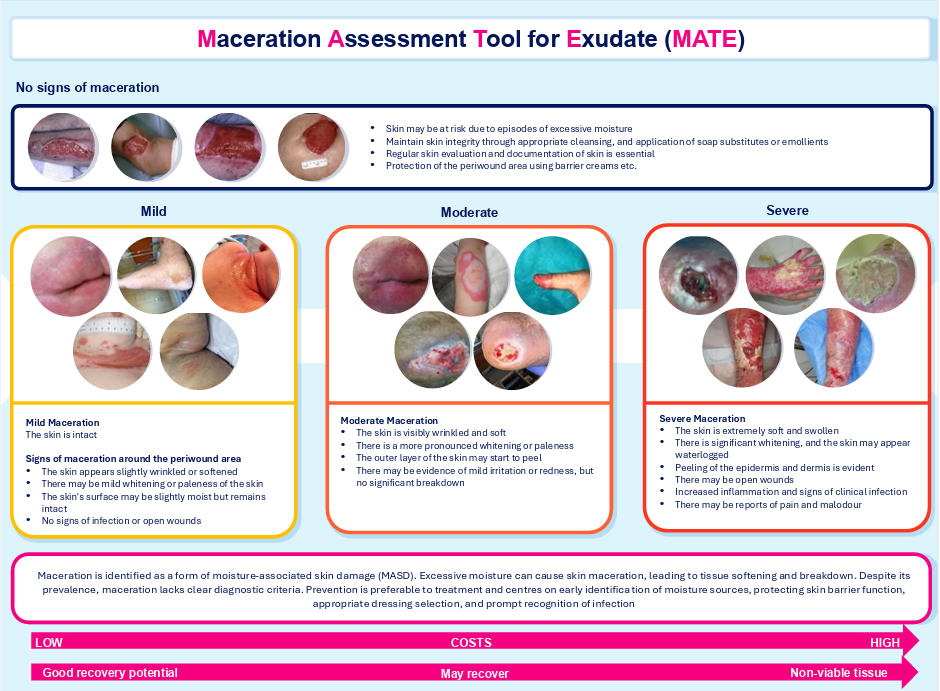
While the issues surrounding maceration and assessment are well documented, the group emphasised that reiterating known challenges will not drive change. Instead, the focus should be on activating behavioural change among frontline staff. A visual Maceration Assessment Tool for Exudate (MATE) was developed to support this goal, offering practical guidance for healthcare professionals [Figures 1a and 1b] alongside a maceration assessment decision tree [Figure 2].
Summary
The focus groups explored the multifaceted nature of maceration occurrence and management, shaped by clinical expertise, operational constraints and behavioural dynamics within healthcare settings. Addressing these challenges requires more than appropriate product selection; it demands a strategic and integrated approach. Maceration in wound care is not solely a consequence of exudate, but rather the outcome of a complex interplay between wound characteristics, dressing performance, use of supporting adjunct therapies such as compression, dressing change frequency, patient factors and environmental conditions.
To support clinicians in making timely and informed decisions, the development of a visual maceration assessment tool was strongly recommended. Such a tool would act as a bridge between theoretical understanding and practical application, reinforced by targeted education and the sustainable use of products. Embedding maceration assessment into routine practice has the potential to enhance early identification, guide appropriate interventions and promote consistency in care.
Download the PDF below to access the full resource, including figures.